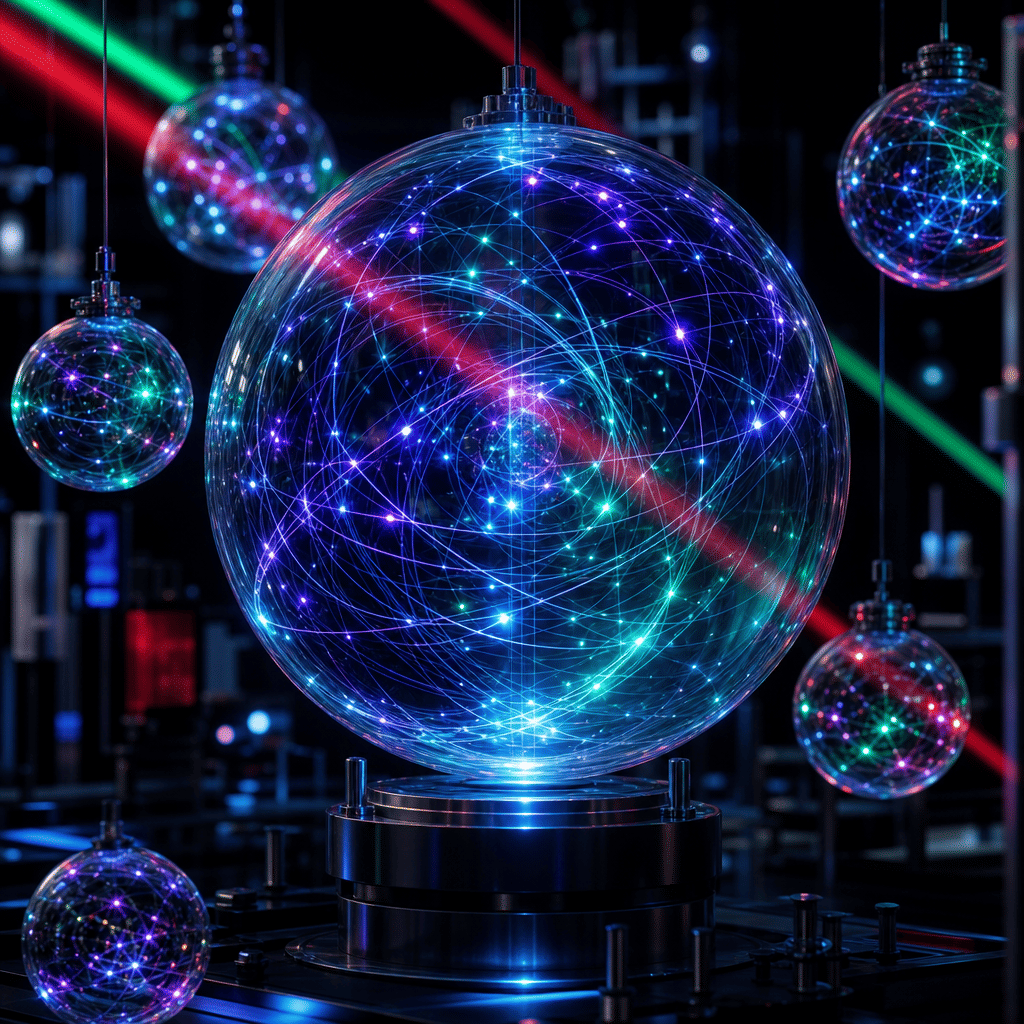
Quantum physics, a realm once confined to the theoretical musings of a select group of physicists, is now driving a scientific and technological revolution. At the heart of this transformation are recent discoveries that have not only deepened our understanding of the quantum world but are also laying the groundwork for advances that could surpass the leaps made during the classical computing era. This article delves into these quantum mysteries and highlights the innovations taking shape at the intersection of theory and application.
Central to the enigma of quantum physics is the dual nature of particles, exemplified by the concept of wave-particle duality. The seminal double-slit experiment illustrated that particles such as electrons exhibit both wave-like and particle-like properties, depending on how they are observed. This revelation was only the beginning of a series of discoveries that challenge our preconceived notions of reality—such as superposition, where particles can exist in multiple states simultaneously, and entanglement, which Einstein famously referred to as “spooky action at a distance.”
In recent years, experimental breakthroughs have propelled these fundamental insights from the realm of abstract thought to tangible reality. One of the most monumental advances is in the development and refinement of quantum computers. Unlike classical computers, which encode information in binary bits (0s and 1s), quantum computers use qubits that can represent and solve complex problems at unprecedented speeds through superposition.
These machines hold the promise of revolutionizing fields such as cryptography, where quantum algorithms could crack codes unimaginable for classical computers. Similarly, in drug discovery, quantum simulations can model complex molecular interactions that were previously intractable, accelerating the creation of new medicines and materials.
The peculiar property of quantum entanglement has also begun to find applications beyond theoretical physics, particularly in the field of quantum communication. Quantum networks leverage entangled particles to create ultra-secure communication channels, immune to conventional eavesdropping tactics. By distributing entangled particles to multiple locations, information can be shared instantaneously and securely, heralding a new era in data transmission.
Moreover, the recent observation of matter behaving quantum mechanically at larger scales, such as in Bose-Einstein condensates, opens up innovative avenues in technology and materials science. These exotic states of matter, a gas of atoms cooled to near absolute zero, can create superconductors that conduct electricity without resistance, potentially revolutionizing energy efficiency in everything from power grids to magnetic levitation.
The pursuit of understanding quantum physics is also shedding light on the fundamental nature of reality. Quantum mechanics challenges our classical notions of space and time, suggesting that reality may be more interconnected and less deterministic than previously theorized. This quantum perception of nature's interconnectedness offers not just scientific and technological opportunities, but existential ones, influencing philosophical discourses about the nature of reality and our place within it.
While the world of quantum physics is undeniably complex and sometimes counterintuitive, its exploration continues to enthral the scientific community and the broader public. As researchers forge ahead, deciphering the intricate tapestry of quantum mechanics, the implications for technology, security, and our understanding of the universe only promise to deepen and expand. As we stand on the precipice of this quantum frontier, the mysteries it unveils inspire both awe and anticipation for the transformative prospects ahead.